

















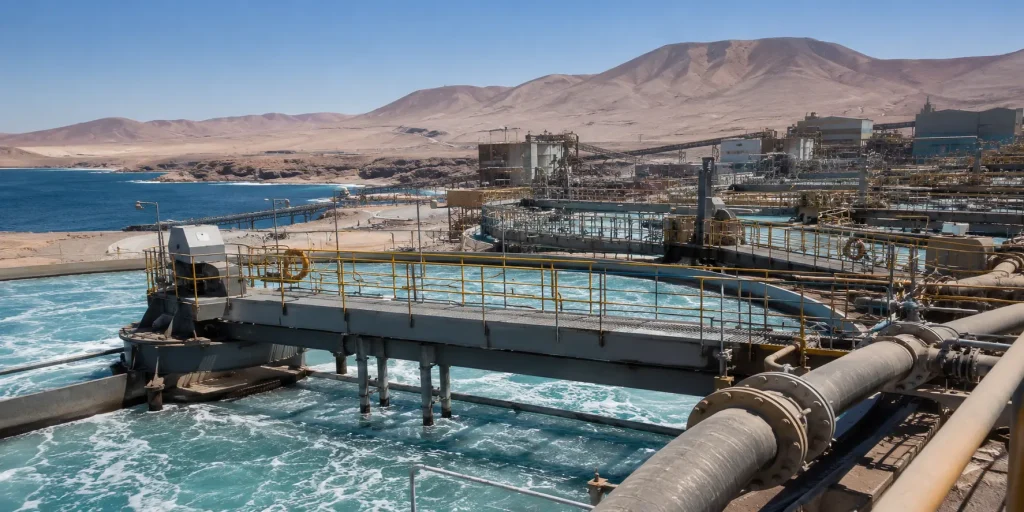
Seawater is no longer a backup option for Chile’s copper mining industry: it is becoming the sector’s main source of water supply. Cochilco projects its share will rise from 40.7% in 2024 to 67.6% in 2034, a leap that forces operators to rethink processes that were designed for fresh water for decades.
In flotation, this shift is not a simple swap of one input for another. Salinity, calcium and magnesium ions, pH and deposit mineralogy interact with each other and change how particles, bubbles and reagents behave inside the cell. That is why seawater flotation is best viewed as a complete system, not as a recipe that can be moved from one plant to the next.
Seawater can be used in flotation circuits, but its ionic composition and pH control can alter the floatability of copper and molybdenum minerals, as well as froth behavior. The selection of collectors, frothers, depressants and modifiers must be validated through metallurgical testing under the actual water and mineralogy conditions of each operation.
Why Seawater Is Gaining Ground in Chilean Mining
Cochilco’s figure turns seawater into a structural variable, not a regional exception. The trend hits hardest in northern Chile, where much of the country’s copper production is concentrated and pressure on inland water sources is greatest. For operations that process sulfide ores through concentration, water availability is no longer the only question: they also need to understand how that water affects metallurgical performance.
At Mathiesen Chile, this trend translates into a concrete need: evaluating flotation reagents and operating conditions according to each plant’s reality, whether the circuit uses raw seawater, blended water or desalinated water.
What Changes in Flotation When Seawater Is Used?
The underlying difference lies in the high concentration of dissolved salts and in the ionic species that modify surface phenomena. In practice, this can show up in mineral hydrophobicity, the way reagents adsorb, froth stability, fines dispersion, selectivity between valuable minerals and gangue, and the metallurgy of by-products such as molybdenum, which is strongly affected by calcium and magnesium ions.
Variable | What may change | Why it must be evaluated |
Salinity and ionic strength | Particle–bubble interactions and froth behavior | The effect depends on mineralogy, salt concentration and the reagent scheme. |
Calcium and magnesium | May form hydroxylated species or precipitates at alkaline pH | These species can coat mineral surfaces, alter their hydrophobicity or negatively affect copper by-products such as molybdenum. |
Circuit pH | Chemical speciation, selectivity and sulfide response | In Cu-Mo systems using seawater, high alkaline values require special attention. |
Mineralogy and clays | Dispersion, heterocoagulation and reagent consumption | Micas, clays and fines can change the metallurgical response in saline media and, with it, the flotation process. |
Collectors and frothers | Adsorption, recovery, bubble size and froth stability | The optimal dosage and combination in fresh water do not necessarily transfer without validation. |
The Role of pH and Calcium and Magnesium Ions
Of all the variables, pH is probably the most sensitive one in Cu-Mo flotation with seawater. A study published in Minerals Engineering recorded strong molybdenite depression in seawater above approximately pH 9.5, associated with the formation of magnesium species on the mineral surface.
Later research on the effects of Mg²⁺ and Ca²⁺ confirmed that these cations can reduce the floatability of molybdenite and chalcopyrite under certain alkaline conditions. This does not mean there is a universal, correct pH for every operation; it means the chemical environment has to be defined ore by ore, based on recovery and selectivity targets and the reagent scheme in use.
What is clear is that carrying a fresh-water strategy straight into a seawater circuit is a risk. The operating point is validated through tests that reproduce the actual water quality, the presence and characterization of ions, the mineral composition (including by-products of interest) and circuit conditions.
Collectors: Selectivity Under Different Water Chemistry
Mining collectors are what make the target mineral species hydrophobic, so their performance is key to efficient separation. With seawater in the circuit, that performance may depend on the surface chemistry created by salinity, pH, divalent ions and the presence of fines.
That is why comparing collectors on recovery and concentrate grade alone falls short. Flotation kinetics, selectivity against pyrite or other species, compatibility with frothers and how stable the response remains when the water changes also need to be considered. In complex or polymetallic ores, small adjustments to circuit chemistry can significantly shift the balance between recovery and selectivity.
Frothers: Salinity Also Affects the Froth Phase
Flotation frothers regulate bubble size, froth stability and particle transport to the concentrate, and they govern the critical coalescence concentration (CCC).
Seawater can alter bubble coalescence and froth response, so a dosage that works well in fresh water should not be taken for granted in a saline medium without testing it first.
Technical evaluation has to look beyond recovery: froth depth, froth stability, gangue entrainment, drainage, selectivity and concentrate quality. A more stable froth does not always mean a better metallurgical result; sometimes it means exactly the opposite.
Depressants, Modifiers and Dispersants: An Integrated View
Seawater flotation also requires a review of depressants, pH regulators, dispersants and other modifiers. In systems containing clays or micas, for example, the interaction between fines, salts and calcium and magnesium species can affect dispersion and coat mineral surfaces.
A study by researchers at the University of Concepción evaluated inorganic dispersants in chalcopyrite and molybdenite flotation with seawater and showed that the effect of these additives depends on how minerals, fines and ionic species interact with each other. It is one more argument for evaluating the circuit as a whole rather than each reagent separately.
Raw Seawater and Desalinated Water Are Not the Same Scenario
A plant can be supplied with raw seawater, conditioned water, blends of different sources or desalinated water, and each one creates a different chemical scenario. Membrane salt separation and other desalination technologies are a separate topic, covered within Mathiesen’s water treatment portfolio. The focus here is different: how the quality of the water that actually reaches the flotation circuit shapes the metallurgical response.
The decision to desalinate, condition or use partially treated seawater depends on each operation’s design and on its own technical, economic and environmental assessments. From a flotation standpoint, what matters is properly characterizing the process water and testing the reagent scheme under that real condition, not under an assumption.
This does not mean desalination is losing relevance. Quite the opposite: the national survey by ACADES and Consejo Minero projects that Chile’s installed desalination capacity could triple by 2028 (from 8,200 to 25,000 liters per second if the projects in the pipeline go ahead), and mining already accounts for more than 80% of that capacity. Choosing between raw, conditioned or desalinated seawater is not a contest between one technology and another, but an engineering decision specific to each plant — and in many operations both coexist within the same circuit.
How to Evaluate a Reagent Scheme for Seawater Flotation
Before scaling any formulation change up to plant level, it is worth building an evaluation matrix that covers the circuit’s critical variables:
- Mineralogical characterization and proportion of Cu, Mo and Fe species and relevant gangue.
- Water composition: salinity, Ca²⁺, Mg²⁺, sulfates and other species of interest.
- Natural pH and target operating range.
- Type and dosage of collector, frother, depressant and modifiers, aiming to identify the chemical molecules that perform best with seawater.
- Recovery kinetics and concentrate grade.
- Froth behavior, gangue entrainment and operational stability.
- Effect of fines, clays or micas when present.
- Repeatability of results and sensitivity to variations in water or ore.
Grupo Mathiesen’s Mining Division has an R&D center, a metallurgical laboratory, rougher and selective flotation testing, kinetic studies, frothing tests and specialty reagent development. Its lines of work include reagents for seawater flotation designed to perform across a wide pH range. Even so, their application to a specific operation must be validated experimentally with that plant’s own mineralogy and process water.
Why Operating at a Lower pH Can Matter
In Cu-Mo circuits using seawater, operating in highly alkaline ranges can promote the formation of magnesium and calcium species that alter the floatability of certain minerals. That is why one of the industry’s research lines has been to explore more moderate pH ranges, together with reagent schemes — selective collectors — capable of sustaining recovery and selectivity under those conditions.
This does not mean a lower pH is automatically better. The result depends on the ore, on whether pyrite or other species need to be controlled, on the available water and on the reagents selected. The right approach is to validate, for each plant, the operating point that delivers the best metallurgical balance.
Pyrite depression, traditionally achieved by raising pH with lime, can also be handled successfully when seawater is used, with sodium metabisulfite (MBS) as the pyrite depression mechanism.
Chile: A Water Trend That Demands More Process Engineering
Cochilco’s 2025–2034 projection confirms that seawater will keep gaining ground in Chilean copper mining. For concentrator plants, this makes water management inseparable from metallurgy, because the water source changes the chemical environment in which reagents work.
The challenge, then, is not only having water available, but designing a process strategy capable of sustaining recovery, selectivity and operational stability when the chemistry of the medium changes. That requires characterization, metallurgical testing and reagent adjustment, one ore body at a time.
Conclusion
The growth of seawater use in Chilean mining opens a real opportunity to reduce dependence on inland water sources, but it brings chemical variables that must be built into flotation design and optimization. Calcium, magnesium, salinity, pH, mineralogy and froth behavior are part of the same system and can change the response of collectors, frothers, depressants and other reagents.
Reagent selection should not start from a standard formula, but from tests that reproduce the real conditions of each operation. To learn about the reagent portfolio, laboratory capabilities and metallurgical support available, contact Mathiesen’s mining team.
Frequently Asked Questions About Seawater Flotation
Can seawater be used directly in copper ore flotation?
Yes. Some operations already run flotation circuits with seawater, and there is a solid body of research on the subject. However, its use requires a prior assessment of ore mineralogy, water composition (salinity, Ca²⁺, Mg²⁺ and sulfates), pH and the reagent scheme, because the metallurgical response can differ considerably from the one obtained with fresh water. Laboratory flotation tests under real process-water conditions are the recommended first step.
How do calcium and magnesium affect seawater flotation?
Under certain conditions, especially at alkaline pH, calcium and magnesium can form hydroxylated species or precipitates that coat mineral surfaces and change their hydrophobicity. In Cu-Mo systems this can significantly depress molybdenite and also affect chalcopyrite. The size of the effect depends on the concentration of these ions, the ore mineralogy and circuit conditions, so it has to be measured plant by plant rather than assumed.
Why is pH so critical in Cu-Mo flotation with seawater?
Because pH changes the chemical speciation of the entire system. In seawater, highly alkaline ranges favor the formation of magnesium and calcium species that reduce the floatability of minerals such as molybdenite; research published in Minerals Engineering observed strong molybdenite depression above roughly pH 9.5. For that reason, the operating range has to be validated through testing instead of being carried over from fresh-water practice.
Do collectors and frothers need to be changed when using seawater?
Not necessarily, but their type, combination and dosage should be revalidated. Salinity and the ionic composition of seawater can change how reagents adsorb, how stable the froth is and how selective the separation becomes. A formulation optimized in fresh water should not be extrapolated without prior testing, and the evaluation should look beyond recovery to kinetics, concentrate grade, gangue entrainment and froth stability.
Does all water need to be desalinated before it is used in flotation?
There is no single answer. Some operations use raw or conditioned seawater, others rely on desalinated water or blends of different sources, and many combine them within the same circuit. The right option depends on the operation’s design, water chemistry, ore mineralogy and each project’s technical, economic and environmental assessment. From a flotation standpoint, what matters is characterizing the process water that actually reaches the circuit
References
- Cochilco — Projection of water consumption in copper mining 2025–2034
- Minerals Engineering (2013) — Molybdenite flotation in seawater and the effect of pH
- Minerals (2021), 11(5), 539 — Inorganic dispersants in chalcopyrite and molybdenite flotation with seawater
- ACADES / Consejo Minero — National survey of desalination plants and projects in Chile