












Chile is seeking to position green hydrogen as a new industry linked to decarbonization, productive development and exports. The 2026-2030 update of the National Green Hydrogen and Derivatives Strategy reinforces this direction and sets milestones for developing demand, infrastructure, local suppliers and industrial-scale projects.
According to information published by Chile’s Ministry of Economy, Development and Tourism, the country has a portfolio of green hydrogen and derivatives projects approved or under environmental assessment representing more than USD 30 billion in investment. If developed, these projects could reach a combined production capacity of close to 980,000 tonnes per year.
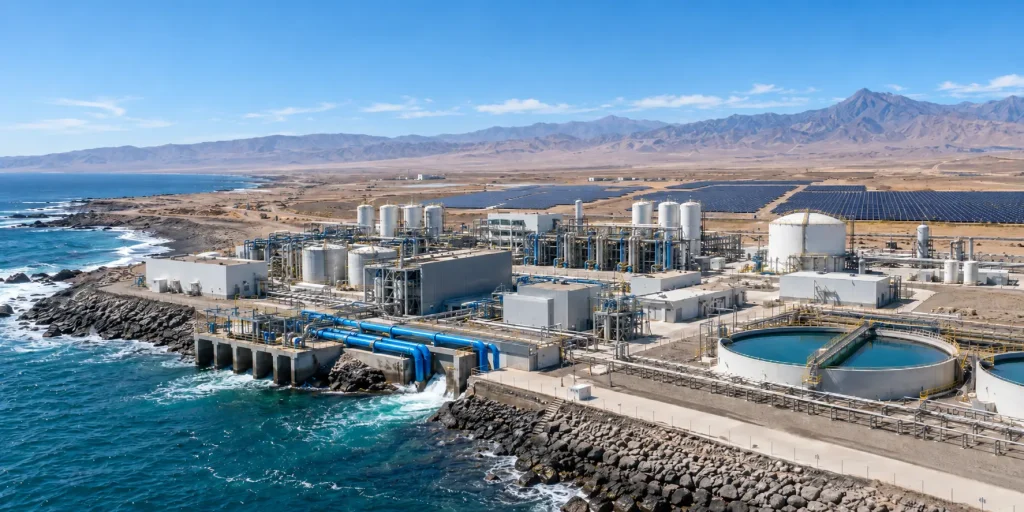
Producing green hydrogen, however, requires much more than renewable electricity and electrolyzers. The value chain also needs controlled-quality water, water treatment and purification, desalination, membrane technologies, infrastructure protection, process chemicals and solutions that help maintain reliable industrial operations.
What Is Green Hydrogen and How Is It Produced?
Green hydrogen is hydrogen produced through water electrolysis using electricity from renewable energy sources. In an electrolyzer, electrical energy separates water molecules into hydrogen and oxygen. When the electricity comes from renewable sources such as solar or wind power, the process can significantly reduce the emissions associated with hydrogen production compared with conventional fossil-fuel-based routes.
Water quality is a relevant technical factor. Feedwater must meet the electrolyzer manufacturer’s specifications and, depending on its source, may require pretreatment, desalination, demineralization and polishing stages before entering the equipment.
What Is Green Hydrogen Used For?
Green hydrogen is particularly relevant in activities where direct electrification is difficult or where hydrogen is already used as an industrial feedstock. Its main applications include:
- mining and high-temperature industrial processes;
- the chemical industry and raw material production;
- heavy-duty and long-distance transport;
- green ammonia production and lower-carbon fertilizers;
- e-methanol, e-gasoline and other synthetic fuels;
- maritime and logistics applications.
Green Hydrogen in Chile: Current Landscape
Chile’s green hydrogen industry combines demonstration facilities already in operation with industrial projects that have advanced through environmental assessment. Each initiative is at a different stage, so environmental approvals should be distinguished from a final investment decision and the actual start of construction.
Project | Region | Product / focus | Verified milestone |
HIF Haru Oni | Magallanes | e-Methanol and e-Gasoline | Operating since 2022; RFNBO certification renewed in July 2026 |
HNH Energy | Magallanes | Green hydrogen and ammonia | Environmental approval granted on August 25, 2026; approximately USD 11 billion declared investment |
HyEx | Antofagasta | Green hydrogen and ammonia | Hydrogen production and ammonia synthesis projects with favorable environmental qualification |
Project status sources: HIF Haru Oni; 2026 RFNBO certification renewal; SEA – HNH Energy; SEA – HyEx.
The 2026-2030 National Strategy includes a milestone for at least two industrial-scale projects to reach a final investment decision (FID) by 2030. This confirms that the sector has moved forward, while still remaining in a phase of industrial maturation.
Water: A Critical Input for Electrolysis
Water is a direct feedstock for electrolysis. From a stoichiometric standpoint, approximately 9 kg of water are required to produce 1 kg of hydrogen. IRENA notes that actual plant water consumption can be higher once purification, demineralization and other process requirements are considered.
In areas with limited availability of industrial freshwater, seawater desalination and water reuse become particularly relevant alternatives. Chile’s national strategy explicitly includes the sustainable use of desalinated and/or recycled water among the milestones for developing the industry.
For a more detailed look at seawater treatment within Mathiesen’s English content, see SWC Membranes in Seawater Desalination. In this green hydrogen article, the focus is on understanding where desalination fits into the hydrogen production chain.
What Role Do Desalination and Membranes Play?
Seawater is not used directly in conventional commercial electrolyzers. It must first be treated to reduce solids, microorganisms and dissolved salts, and then conditioned until it reaches the water quality required by the electrolysis process.
A treatment train may combine pretreatment, filtration or ultrafiltration, microbiological control, reverse osmosis desalination and downstream purification. Mathiesen’s Water Treatment portfolio includes reverse osmosis, nanofiltration, ultrafiltration, microfiltration and desalination membrane technologies for industrial applications.
After desalination, additional polishing may be required depending on permeate quality and the electrolyzer specification. High-rejection reverse osmosis and ion exchange resins can form part of the purification scheme, depending on the system design.
Membrane operation also requires control of scaling and fouling. Antiscalants, pH adjustment, biocides and chemical cleaning programs can help protect system performance. For the design and operation principles behind RO systems, Mathiesen also provides an English technical article on how to design a successful reverse osmosis system.
Raw Materials and Solutions Across the Value Chain
A green hydrogen project involves technical requirements that extend well beyond the electrolyzer. From water intake to auxiliary process systems, the following families of solutions may be involved:
Stage | Technical challenge | Related solutions |
Water pretreatment | Suspended solids and turbidity | Coagulants, flocculants, filters and ultrafiltration |
Microbiological control | Biofouling | Biocides and microbiological control solutions |
Desalination | Salt removal | Seawater reverse osmosis membranes |
Membrane protection | Scaling and fouling | Antiscalants, pH adjustment and chemical cleaning |
Final purification | Water quality for electrolysis | High-rejection RO, ion exchange resins and polishing |
Infrastructure | Corrosion and marine exposure | Resins, coatings and corrosion-protection systems |
Thermal management | Temperature control | Glycols and heat-transfer fluids |
Auxiliary circuits | Foam formation | Defoamers |
Ammonia production | Synthesis and purification | Catalysts, supports and process chemicals, depending on technology |
Mathiesen’s Water Treatment portfolio combines specialty chemicals, membrane technologies, ion exchange resins and filtration solutions. For a closer look at coagulation and flocculation in industrial applications, see Industrial Water Treatment: Solid-Liquid Separation.
Infrastructure Protection and Auxiliary Processes
Projects located in marine, desert or extreme-climate environments must account for corrosion, salinity, humidity, solar radiation and temperature variations. Epoxy resins and other industrial-coating components can be used in formulated systems designed to protect metal structures, piping and exposed surfaces.
At the same time, cooling and heat-transfer systems may use glycols and other raw materials for the chemical industry, while industrial defoamers may be used in water circuits and auxiliary processes when foam control is required.
From Green Hydrogen to Green Ammonia
One of the routes of greatest interest for Chile is converting renewable hydrogen into ammonia. In the Haber-Bosch process, hydrogen is combined with nitrogen to produce ammonia. When the hydrogen and energy used in the process come from renewable sources, the resulting product can be classified as green ammonia under the applicable project and market criteria.
This route allows hydrogen to be used as a chemical feedstock while also supporting certain transport, storage and export options. The HNH Energy project in Magallanes is a concrete example of this industrial direction.
An Opportunity for Industrial Suppliers in Chile
The emerging industry will not consist only of energy producers and electrolyzer manufacturers. It will also require suppliers of water technologies, chemicals, coatings, logistics, engineering, maintenance and specialized services.
The 2026-2030 National Strategy includes among its milestones the development of domestic suppliers of goods and services across the value chain. This creates an opportunity to transfer capabilities already developed in mining, water treatment, the chemical industry and industrial coatings into new green hydrogen applications.
Mathiesen Solutions for the Green Hydrogen Value Chain
Mathiesen has regional experience in supplying raw materials and providing technical support to process-intensive industries. In the green hydrogen value chain, its contribution can focus especially on water treatment and purification, complemented by solutions for infrastructure and auxiliary processes.
- Reverse osmosis, nanofiltration and ultrafiltration technologies. See the Water Treatment portfolio.
- Membranes for seawater desalination. See SWC Membranes in Seawater Desalination.
- Ion exchange resins for polishing and high-purity water applications. See Ion Exchange Resins – Use in Water Treatment.
- Coagulation and flocculation for pretreatment and solid-liquid separation. See Industrial Water Treatment: Solid-Liquid Separation.
- Glycols, heat-transfer fluids and specialties for auxiliary processes. See Chemical Industry: Raw Materials and Solutions.
- Antiscalants, biocides and chemical-cleaning specialties for membrane protection and operation.
- Cartridge filters and other filtration solutions for pretreatment and polishing.
- Epoxy resins and other raw materials for coatings and corrosion protection.
- Industrial defoamers and other specialties for auxiliary water circuits and process systems.
Technical value does not come only from having a product portfolio. It comes from selecting solutions according to actual water quality, operating conditions, compatibility between treatment stages and process requirements. This approach allows Mathiesen to participate in the value chain as a specialized industrial supplier without presenting itself as the developer or overall designer of a green hydrogen project.